FoscTimeSignature
Returns a FoscTimeSignature.
Description
Time signature.
Attributes Summary
| context |
Gets context of time signature. |
| denominator |
Gets denominator of time signature: |
| duration |
Gets duration of time signature. |
| hasNonPowerOfTwoDenominator |
Is true when time signature has non-power-of-two denominator. |
| hide |
Is true when time signature should not appear in output (but should still determine effective time signature). |
| impliedProlation |
Gets implied prolation of time signature. |
| numerator |
Gets numerator of time signature. |
| pair |
Gets numerator / denominator pair corresponding to time signature. |
| parameter |
Is true. |
| partial |
Gets duration of pick-up to time signature. |
| tweaks |
Tweaks are not implemented on time signature. |
| add |
!!!TODO: incomplete |
| copy |
Copies time signature. |
| == |
Is true when arg is a time signature with numerator and denominator equal to |
| format |
Formats time signature. |
| >= |
Is true when duration of time signature is greater than or equal to duration of arg. Otherwise false. |
| > |
Is true when duration of time signature is greater than duration of arg. Otherwise false. |
| <= |
Is true when duration of time signature is less than or equal to duration of arg. Otherwise false. |
| < |
Is true when duration of time signature is less than duration of arg. Otherwise false. |
| [(abjad:](#(abjad:) |
radd) |
| str |
Gets string representation of time signature. |
Usage
Example
a = FoscStaff(FoscLeafMaker().(#[60,62,64], [1/8]));
m = FoscTimeSignature(#[3,8]);
a[0].attach(m);
a.show;
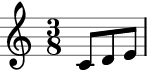
!!!TODO: not yet working
Create a score-contexted time signature. Score-contexted time signatures format behind comments when no Abjad score container is found.
a = FoscStaff(FoscLeafMaker().(#[60,62,64], [1/8]));
m = FoscTimeSignature(#[3,8]);
a[0].attach(m, context: 'Score');
a.format;
\new Staff {
    \time 3/8
    c'8
    d'8
    e'8
}
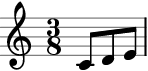
Score-contexted time signatures format normally when an Abjad score container is found.
a = FoscScore([a]);
a.show;
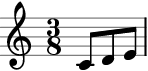
!!!TODO: tags not yet implemented
Time signatures can be tagged.
a = FoscStaff(FoscLeafMaker().(#[60,62,64], [1/8]));
m = FoscTimeSignature(#[3,8]);
a[0].attach(m, tag: "RED");
a.format;
\new Staff {
    \time 3/8
    c'8
    d'8
    e'8
}
Gets context of time signature.
Example
a = FoscTimeSignature(#[3,4]);
a.context.postln;
Staff
Gets denominator of time signature:
Example
a = FoscTimeSignature(#[3,4]);
a.denominator.postln;
4
Gets duration of time signature.
Example
a = FoscTimeSignature(#[3,4]);
a.duration.postcs;
FoscDuration(3, 4)
Is true when time signature has non-power-of-two denominator.
Example
a = FoscTimeSignature(#[7,12]);
a.hasNonPowerOfTwoDenominator.postln;
true
Example
a = FoscTimeSignature(#[3,4]);
a.hasNonPowerOfTwoDenominator.postln;
false
Is true when time signature should not appear in output (but should still determine effective time signature).
Example
a = FoscStaff(FoscLeafMaker().(#[60,62,64,65], [1/4]));
m = FoscTimeSignature(#[4,4]);
a[0].attach(m);
m = FoscTimeSignature(#[2,4], hide: true);
a[2].attach(m);
a.format;
\new Staff {
    \time 4/4
    c'4
    d'4
    e'4
    f'4
}

!!!TODO: bug: result should be [[4,4],[4,4],[2,4],[2,4]]
FIXME: ERROR: Message byLeaf not understood.
iterate(a).byLeaf.do { |leaf|
    FoscInspection(leaf).effectiveIndicator(FoscTimeSignature).pair.postln;
};
Gets implied prolation of time signature.
Implied prolation of time signature with power-of-two denominator.
a = FoscTimeSignature(#[3,8]);
a.impliedProlation.postcs;
FoscMultiplier(1, 1)
Implied prolation of time signature with non-power-of-two denominator.
a = FoscTimeSignature(#[7,12]);
a.impliedProlation.postcs;
FoscMultiplier(2, 3)
Gets numerator of time signature.
Example
a = FoscTimeSignature(#[3,8]);
a.numerator.postln;
3
Gets numerator / denominator pair corresponding to time signature.
Example
a = FoscTimeSignature(#[3,8]);
a.pair.postln;
[ 3, 8 ]
Is true.
Example
a = FoscTimeSignature(#[3,8]);
a.parameter.postln;
true
Gets duration of pick-up to time signature.
Example
a = FoscTimeSignature(#[3,8]);
a.partial.postln;
Tweaks are not implemented on time signature.
The LilyPond \time command refuses tweaks.
Override the LilyPond TimeSignature grob instead.
!!!TODO: incomplete
Adds time signature to timeSignature.
Returns new time signature.
Example
a = FoscTimeSignature([3, 4]);
b = FoscTimeSignature([7, 8]);
c = a + b;
c.pair.postln;
[ 13, 8 ]
Copies time signature.
Is true when arg is a time signature with numerator and denominator equal to this time signature. Also true when arg is a tuple with first and second elements equal to numerator and denominator of this time signature. Otherwise false.
Returns true or false.
Example
a = FoscTimeSignature([3, 4]);
b = FoscTimeSignature([3, 4]);
c = FoscTimeSignature([4, 4]);
d = FoscDuration([3, 4]);
(a == b).postln;
true
false
false
Formats time signature.
Example
a = FoscTimeSignature([3, 8]);
a.format.postln;
Is true when duration of time signature is greater than or equal to duration of arg. Otherwise false.
Returns true or false.
Example
a = FoscTimeSignature([3, 4]);
b = FoscTimeSignature([2, 4]);
(a >= b).postln;
true
false
Is true when duration of time signature is greater than duration of arg. Otherwise false.
Returns true or false.
Example
a = FoscTimeSignature([3, 4]);
b = FoscTimeSignature([2, 4]);
(a > b).postln;
true
false
Is true when duration of time signature is less than or equal to duration of arg. Otherwise false.
Returns true or false.
Example
a = FoscTimeSignature([3, 4]);
b = FoscTimeSignature([2, 4]);
(a <= b).postln;
false
true
a <= 3; // FIXME: ERROR: Message 'duration' not understood.
Is true when duration of time signature is less than duration of arg. Otherwise false.
Returns booelan.
Example
a = FoscTimeSignature([3, 4]);
b = FoscTimeSignature([2, 4]);
(a < b).postln;
false
true
radd)
!!!TODO: see FoscFraction:performBinaryOpOnSimpleNumber
Gets string representation of time signature.
Example
a = FoscTimeSignature([3, 4]);
a.str;
3/4
Makes new time signature equivalent to current time signature with power-of-two denominator.
Returns new time signature.
Example
FoscTimeSignature([7, 16]).inspect;
FoscTimeSignature.new